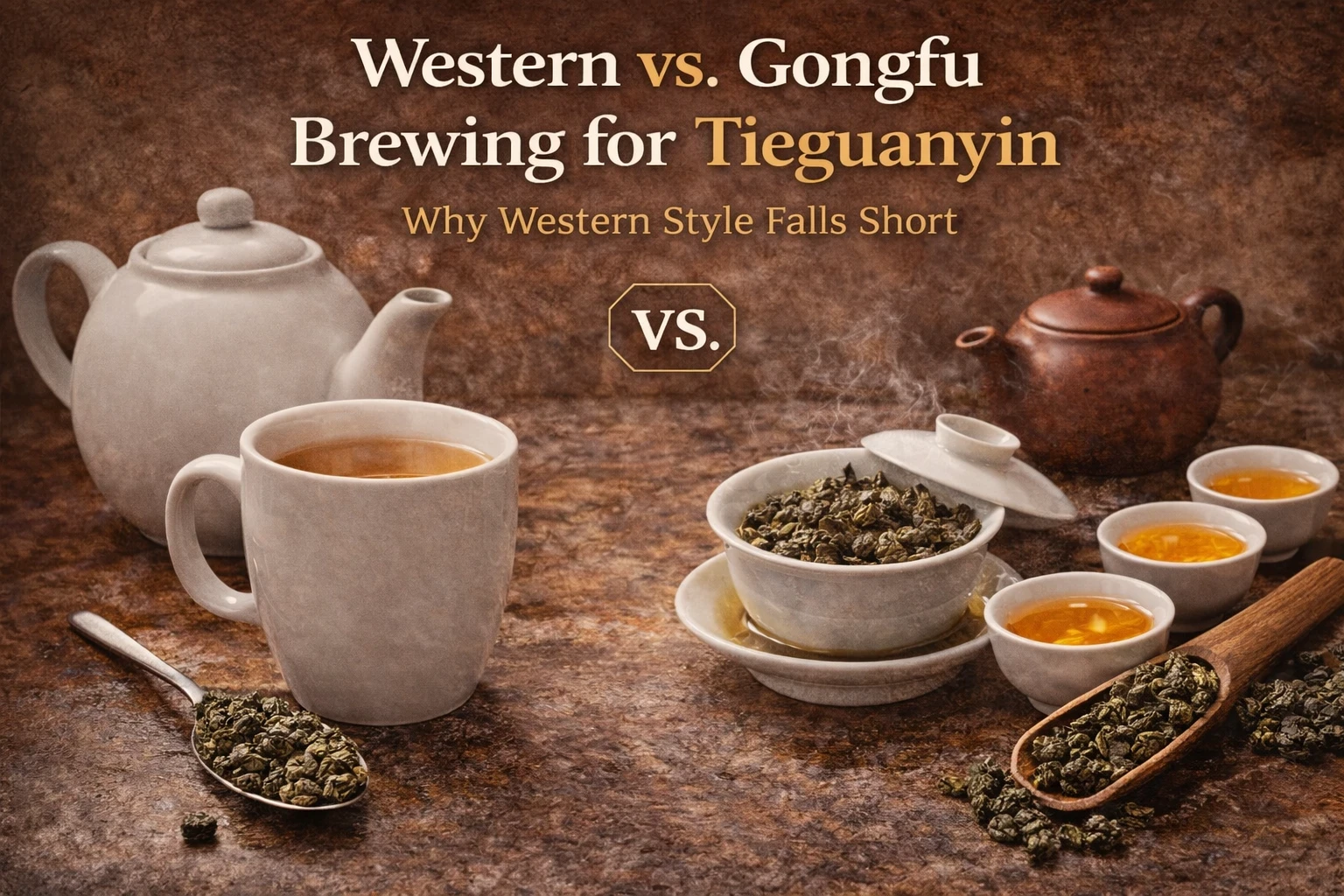
Tieguanyin is one of the most celebrated Chinese oolongs, prized for its layered floral aromas, creamy body, and long finish. If you first encountered it outside of China, chances are you brewed it in a regular mug, steeped it for a few minutes, and ended up with something pleasant but a little unremarkable. That experience is common, and it almost always comes down to brewing method. Tieguanyin was developed within a tea culture that uses very different parameters than Western-style brewing, and when you apply the traditional Gongfu approach, the same leaves produce a noticeably richer and more complex cup. This guide walks through both methods: how each works, why each produces different results, and when one makes more sense than the other.
Why Brewing Style Matters for Tieguanyin
Brewing style is not just a matter of preference or tradition. It directly determines which compounds are extracted from the leaves, in what concentration, and in what order. Change the leaf-to-water ratio, the steep time, or the number of infusions, and you change the tea entirely.
Tieguanyin is a tightly rolled oolong. The leaves take time to fully unfurl, and as they open, they release different flavor and aroma compounds at different stages. A single long steep pulls many of those compounds into the water at once, producing a blended, somewhat flat result. A series of short infusions allows each stage of unfurling to be appreciated separately, revealing the tea’s full range.
Understanding both methods helps you make deliberate choices rather than defaulting to one out of habit. Even if you continue to brew Western style most of the time, knowing what Gongfu brewing reveals will give you a clearer sense of what a given Tieguanyin is actually capable of.
What Is Western Tea Brewing?
Western brewing developed around the equipment and habits of European tea culture: large teapots, standard-size mugs, and one generous infusion per sitting. The approach is built for convenience and accessibility, and it translates well to looseleaf teas of many kinds.
For Tieguanyin brewed Western style, the parameters are straightforward:
• About 1 to 2 teaspoons of dry leaf per 250 to 350 ml of water
• Water temperature around 90 to 95 degrees Celsius
• Steep for 2 to 4 minutes, with a second steep possible if you want to extend the session
The result is a single, full-size cup with a mild floral character and a gentle sweetness. The process is forgiving: small variations in leaf amount or steep time won’t ruin the cup. Cleanup is quick, and no specialized equipment is required.
This is a perfectly reasonable way to enjoy Tieguanyin during a busy morning or when brewing for several people at once. It is also the most common entry point for new looseleaf tea drinkers, which is part of why many people’s first impressions of Tieguanyin are underwhelming. The method works, but it doesn’t show the tea at its best.
What Is Gongfu Brewing?
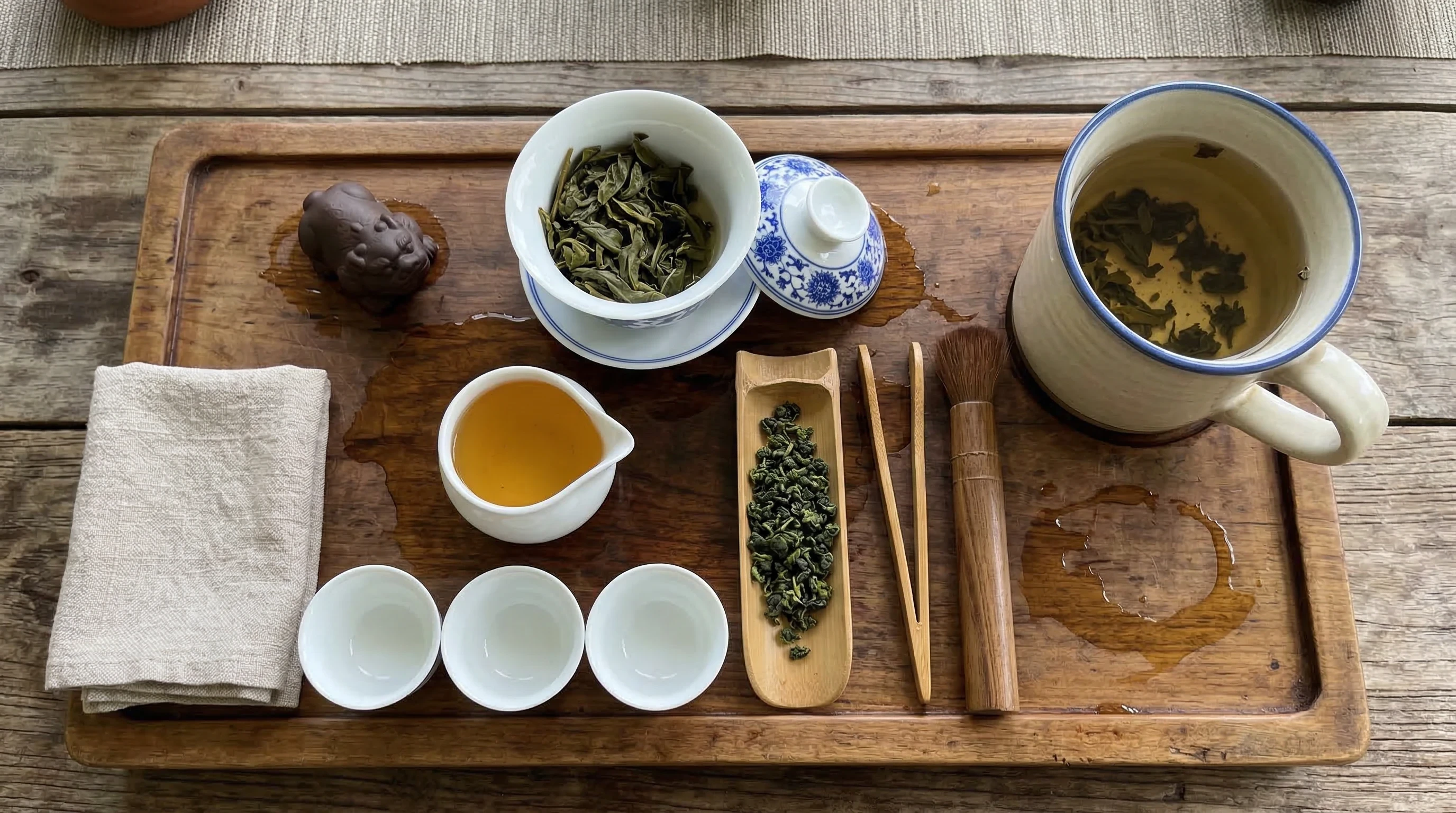
Gongfu brewing is the traditional Chinese approach to oolong tea, developed in Fujian and Guangdong and still widely practiced across China, Taiwan, and Hong Kong. The word “gongfu” refers to skill and attention applied over time, and the method reflects that: it is unhurried, attentive, and designed to extract the most from high-quality leaves.
The core parameters for Gongfu brewing Tieguanyin are:
• About 8 to 10 grams of leaf per 120 to 150 ml brewing vessel
• A small clay or porcelain teapot (yixing) or a lidded bowl called a gaiwan
• First infusions lasting just 10 to 20 seconds
• Steeping time increased gradually with each successive infusion
Rather than producing one large cup, you pour multiple small servings, each holding just 60 to 80 ml. Every infusion offers a slightly different expression of the same leaves. In the early rounds, the rolled leaves are just beginning to open and the flavor is bright and high-pitched. By the third or fourth infusion, the leaves have unfurled fully and the cup takes on a richer, creamier quality. The later infusions become softer and more mineral, sometimes with a lingering sweetness long after the cup is empty.
The ritual aspect of Gongfu brewing is part of its appeal. Watching the tightly balled leaves gradually expand across the session, noticing how the aroma shifts from floral to buttery, and adjusting steep times in response to what you are tasting makes for an engaging experience that is quite different from pouring a mug and walking away.
Key Differences Between Western and Gongfu Brewing
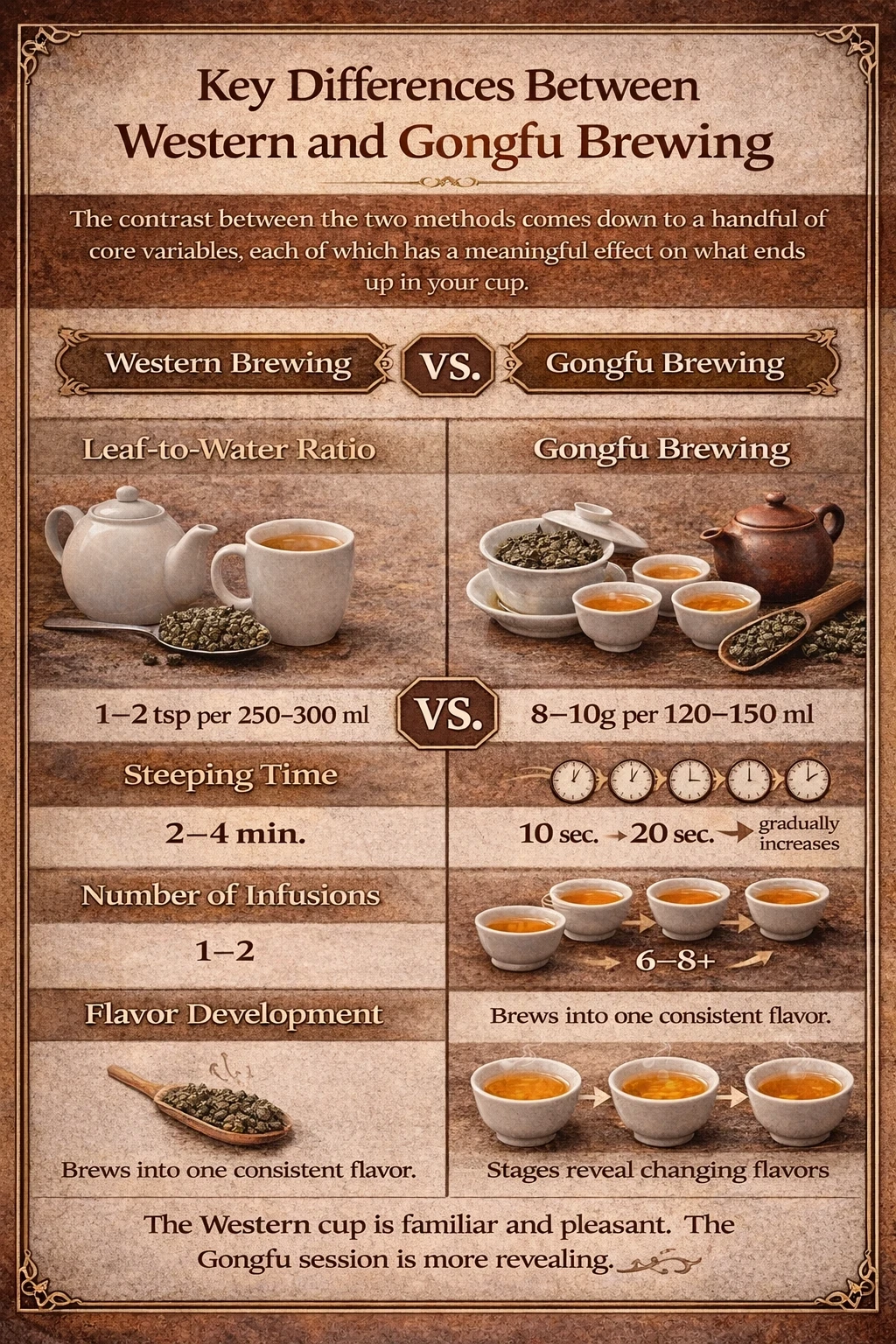
The contrast between the two methods comes down to a handful of core variables, each of which has a meaningful effect on what ends up in your cup.
• Leaf-to-water ratio: Gongfu brewing uses roughly three to four times more leaf relative to water than Western brewing. The higher concentration increases the intensity of both flavor and aroma in each small cup.
• Steeping time: Western brewing uses a single long infusion of 2 to 4 minutes. Gongfu brewing uses many short infusions, often under 30 seconds for the first few rounds, increasing gradually as the session progresses.
• Number of infusions: Western brewing typically yields one solid cup and a weaker second. Good Tieguanyin brewed Gongfu style can deliver 6 to 8 worthwhile infusions, sometimes more.
• Flavor development: A long single steep extracts many flavor compounds simultaneously, merging them into one consistent taste. Short sequential infusions draw out different compounds at different stages, producing a session where the tea genuinely changes from one cup to the next.
The difference is tangible enough that brewing the same Tieguanyin both ways side by side can feel like tasting two different teas. The Western cup is familiar and pleasant. The Gongfu session is more revealing.
How Western Brewing Changes the Taste of Tieguanyin
The main strength of Western brewing is consistency. You know roughly what you are going to get, and with good leaves and properly heated water, the result is reliably drinkable. The cup will have a mild floral note, a light sweetness, and an easy finish with minimal bitterness.
The limitation is that a long steep extracts most flavor compounds at once rather than gradually. The more delicate top notes of Tieguanyin, those bright, almost orchid-like aromas that appear briefly in the first seconds of contact with hot water, get absorbed into the larger volume of liquid and diluted. What you taste is an average of all the flavors rather than the distinct character of each.
The aroma also behaves differently. In a large mug, the fragrance disperses quickly into the surrounding air. In the small cups used for Gongfu brewing, the concentration of aromatic compounds is high enough to linger noticeably, even in an empty cup after the tea has been drunk.
A second Western steep, if attempted, is almost always noticeably thinner. Most of what the leaves had to offer went into the first cup, leaving little behind for a meaningful follow-up.
Why Gongfu Brewing Reveals More Flavor
Tieguanyin is a tightly rolled tea, and the rolling is not merely cosmetic. It allows the leaves to open incrementally, releasing their aromatics and flavor compounds in waves rather than all at once. Gongfu brewing is well suited to this structure.
In the first infusion or two, the leaves are still largely closed. The water touches only the outer surfaces, and what comes through is a light, high-floral note with a clean, almost grassy freshness. The liquor is typically pale and very aromatic.
By the third and fourth infusions, the leaves have opened fully and the gaiwan is noticeably fuller. The flavor becomes richer and creamier, with a buttery body that is characteristic of quality Tieguanyin. These are often the most satisfying rounds of the session.
Later infusions take on a mellower, more mineral character. The intensity fades but the finish lengthens, and there is often a quiet sweetness that persists on the palate between sips. For some drinkers, these final rounds are the most contemplative part of the session.
The high leaf-to-water ratio amplifies all of this. A small volume of quality water in contact with a dense pack of leaves becomes saturated with aromatic compounds quickly, which is why even a 15-second steep at this ratio produces a cup with real character. Western brewing’s lower ratio simply cannot achieve the same concentration, regardless of how long the leaves sit.
A Side-by-Side Brewing Comparison
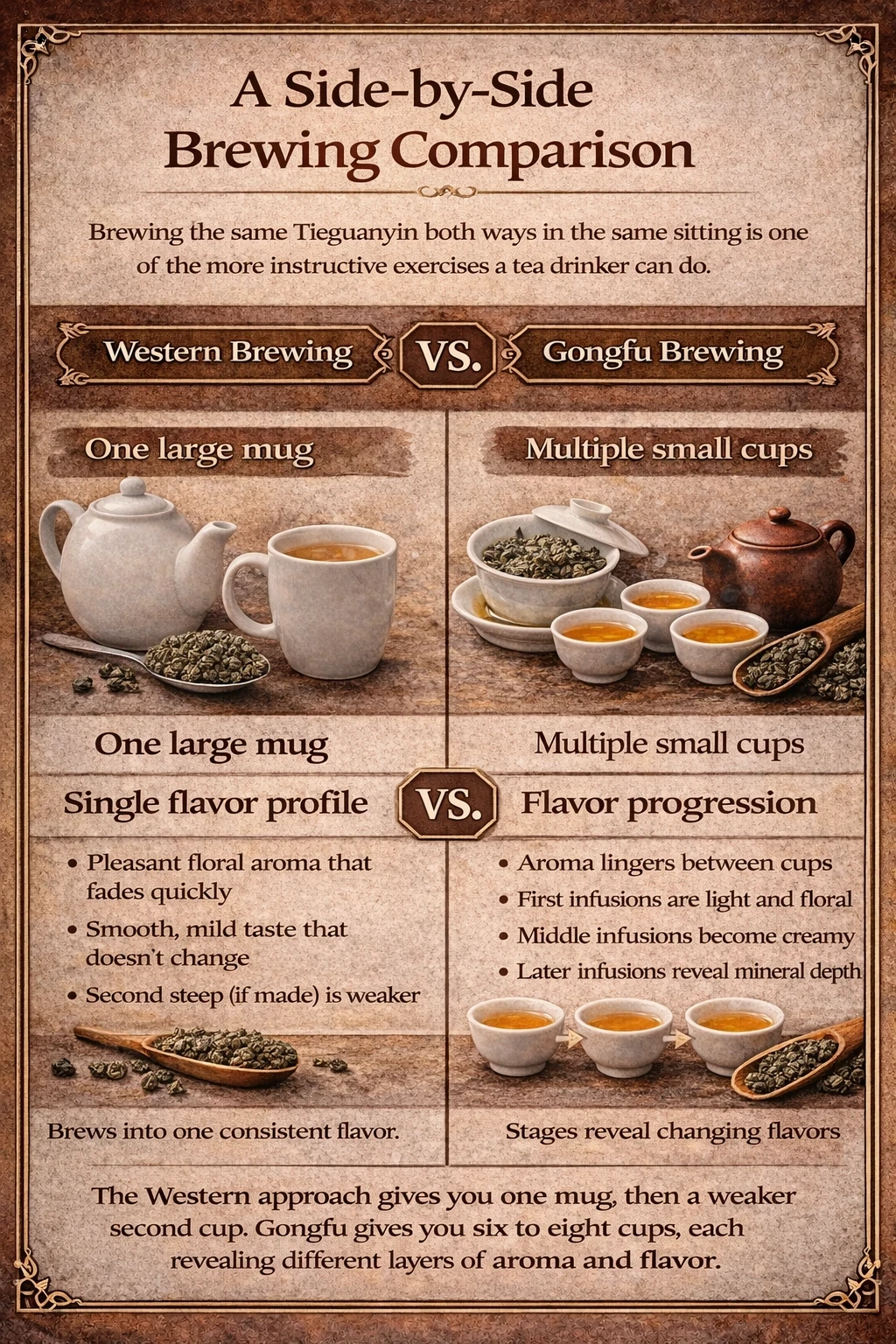
Brewing the same Tieguanyin both ways in the same sitting is one of the more instructive exercises a tea drinker can do. The contrast tends to be sharper than people expect.
The Western mug opens with a pleasant aroma that fades within a minute or two as the heat dissipates. The flavor is smooth and approachable, with a mild floral note and a light sweetness. It does not change much as you drink it. The second steep, if made, is softer and less defined.
The Gongfu session is noticeably more active. The first cup is light but fragrant, with a clarity of aroma that is hard to achieve in a large vessel. The second and third cups are often the highlight: full-bodied, creamy, and richly scented. Holding the empty cup after drinking is worth doing, as the residual warmth releases a concentrated version of the tea’s fragrance. The later rounds are quieter but still interesting, with a mineral depth that rounds out the session.
By the end of a Gongfu session, you have had six or eight small cups from a single measure of leaves, each one slightly different from the last. The Western approach gives you one cup, then a diminished second. When the leaves are good, the difference in overall experience is significant.
When Western Brewing Still Makes Sense
Western brewing is not the wrong way to prepare Tieguanyin. It is a different set of priorities, and there are contexts where those priorities make complete sense.
• On busy mornings when you want something warm and flavorful without a drawn-out process
• When brewing for guests who aren’t interested in a tea tasting session
• When you want a background beverage rather than the focal point of the next hour
• When your equipment is limited to a standard mug or infuser
Western brewing also holds up well with mid-range Tieguanyin, where the complexity is moderate and does not require the nuanced extraction of Gongfu to be appreciated. For a high-quality, freshly sourced Tieguanyin, Gongfu is the better fit. For an everyday affordable option on a weekday afternoon, Western style does the job cleanly.
Choosing Western style is not settling. It reflects a reasonable decision about time, context, and what you want from the session.
When Gongfu Brewing Is the Better Choice
Gongfu brewing earns its reputation when the tea is good and the time is available. If you have purchased a quality Tieguanyin, whether a green-style version or a traditionally roasted one, brewing it Gongfu style is the most reliable way to understand what you are actually drinking.
• When you want to evaluate a new Tieguanyin and understand its character fully
• When you have set aside time for a relaxed, attentive tea session
• When hosting a small tasting for friends who are curious about tea
• When comparing different oolongs or different harvests of the same tea
The Gongfu approach also offers a degree of control that Western brewing cannot match. You can adjust the steep time on each infusion based on what the previous cup tasted like, pulling back if a round came out too strong or extending slightly if the flavor is beginning to thin. Over several sessions, this hands-on process builds a more refined sense of how a particular tea behaves.
It is worth noting that Gongfu brewing is more accessible than it appears. A gaiwan costs very little, and the technique, while deliberate, does not require years of practice. A few sessions are usually enough to feel comfortable, and the improvement in cup quality is immediate.
Practical Tips for Trying Both Methods
The most direct way to understand the difference between Western and Gongfu brewing is to run the comparison yourself. Use the same leaves, the same water, and the same temperature. Brew one cup Western style and run a Gongfu session alongside it.
• Compare the aroma from a full mug versus a small Gongfu cup. The difference in intensity is usually noticeable immediately.
• After finishing a Gongfu cup, hold the empty vessel under your nose. A quality Tieguanyin will leave a distinct fragrance in the warm ceramic.
• Watch how the leaves change across the Gongfu session. By the third or fourth infusion, tightly balled leaves will have opened into full leaf structures, and the gaiwan will look quite different from how it started.
• Keep a simple note of which infusion you found most satisfying. Over multiple sessions, patterns will emerge that tell you something useful about your own preferences.
• Start Gongfu steeps conservatively, around 15 to 20 seconds for the first few rounds, and adjust from there rather than trying to calibrate in advance.
There is no fixed right answer about which method is superior. The better question is which method fits your tea, your time, and your intention on a given occasion.
Frequently Asked Questions
What is the main difference between Gongfu and Western tea brewing?
Western brewing uses a small amount of leaf in a large volume of water, steeped for several minutes to produce a single cup. Gongfu brewing uses a much higher leaf-to-water ratio with many short infusions, drawing out different flavor and aroma compounds in sequence across multiple small cups.
Can Tieguanyin be brewed Western style?
Yes. Western brewing produces a pleasant, accessible cup and works well in contexts where convenience matters more than complexity. The tradeoff is that many of Tieguanyin’s finer qualities, particularly its aromatic range and the progression of flavors, are less apparent in this format.
Which method produces a stronger flavor?
Gongfu brewing produces a more concentrated and layered flavor in each small cup due to the higher leaf-to-water ratio and the staged extraction across multiple infusions. Western brewing produces a milder, more uniform result.
How many times can Tieguanyin be steeped Gongfu style?
A quality Tieguanyin will typically yield 6 to 8 meaningful infusions Gongfu style, and sometimes more depending on the tea and how it is handled. The session is finished when the flavor becomes thin or loses definition.
Is Gongfu brewing difficult for beginners?
It is more involved than Western brewing, but not difficult to begin. A gaiwan and a small pitcher are the only equipment needed to get started. The basic principle is straightforward: use more leaf, use less water, steep briefly, and repeat. Most people find their footing within a few sessions.
Closing Thoughts
Western and Gongfu brewing are not competing approaches so much as they are different tools suited to different situations. Western style offers simplicity, speed, and a consistent result. For a quick cup with breakfast or a casual pot shared with friends, it serves the purpose well and does not ask much of you in return.
Gongfu brewing is something else. It does not simply produce a better cup of the same tea; it reveals a different tea altogether. The progression from bright early infusions to the rich, creamy middle rounds, and then into the quieter mineral finish, is an experience that Western brewing cannot replicate. That is not a criticism of one method or a defense of the other. It is simply what the two approaches are designed to do.
If you have been drinking Tieguanyin Western style and have never tried a proper Gongfu session with the same leaves, the experiment is worth running. The difference tends to be immediately clear, and it gives you a much more accurate picture of why this tea has been valued for so long.
Having both approaches available and knowing when to reach for each is, in the end, the most practical relationship you can have with a tea as capable as Tieguanyin.
Ready to Try Gongfu Brewing with Tieguanyin?
If this comparison has you curious about what your Tieguanyin can really do, the next step is straightforward. Our step-by-step guide to brewing Tieguanyin Gongfu style walks you through everything you need to get started: leaf amounts, water temperature, timing for each infusion, and practical tips to make your first session a good one. No special experience required.
Here’s a little transparency: Our website contains affiliate links. This means if you click and make a purchase, we may receive a small commission. Don’t worry, there’s no extra cost to you. It’s a simple way you can support our mission to bring you quality content.

Chris is the founder of Zen Tea Tools and a passionate explorer of traditional and modern tea brewing. From Gongfu sessions to smart tea technology, he shares practical insights to help others find clarity, calm, and better tea.Learn more about Chris →
Leave a Reply