If you spend enough time drinking Chinese tea, you’ll eventually land on this comparison. Aged white tea and sheng pu’er (raw pu’er) are both known for developing over time in the right conditions, and each has a devoted following that tracks vintages, storage, and flavor shifts closely.
They’re far from the only teas capable of this (some oolongs, dark teas, black teas, and other compressed teas can develop under suitable storage too), but these two are among the most widely discussed examples, and comparing them side by side is a useful way to understand what “aging” actually means for tea.
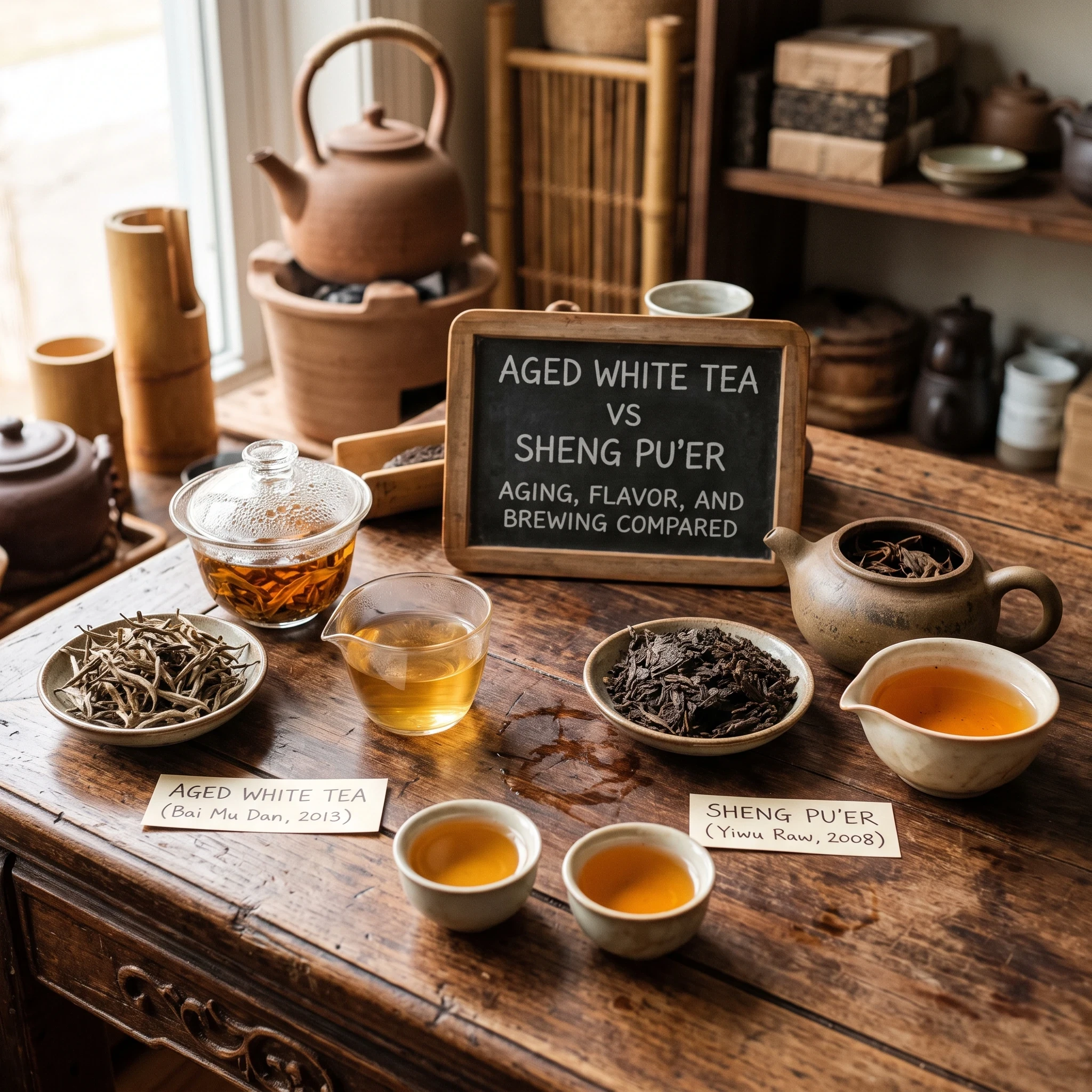
“These teas can age well” doesn’t mean they age the same way. They’re made differently, they transform through different mechanisms, and they end up tasting quite different in the cup. One is generally gentle and forgiving. The other can be intense and demanding, particularly when young.
This article compares the two side by side: production, aging mechanics, flavor, storage, brewing, cost, and which one might suit your palate better. The goal isn’t to crown a winner, but to help you understand what you’re actually comparing.
Aged White Tea and Sheng Pu’er at a Glance
| Aspect | Aged White Tea | Sheng Pu’er |
|---|---|---|
| Tea category | White tea | Raw pu’er tea |
| Main production region | Fujian Province, China | Yunnan Province, China |
| Typical leaf material | Small to medium leaf tea plant varieties, plus buds | Yunnan large-leaf tea material, which may come from plantation bushes, mature arbor trees, or older trees |
| Processing | Withering and drying, minimal handling | Fixing, rolling, sun-drying, then compression |
| Common forms | Loose leaf, cakes, bricks | Loose maocha, cakes, bricks, tuo, mushroom shapes |
| Character when young | Floral, light, sweet, sometimes hay-like | Bright, grassy or floral, often bitter and astringent |
| Character when aged | Honeyed, soft, fruity, herbal | Fruity, woody, earthy, sometimes camphor or incense-like |
| Aging intensity | Gradual, generally gentle | Can be dramatic, especially in well-stored cakes |
| Storage sensitivity | Moderate | High |
| Brewing difficulty | Easy to moderate | Moderate to challenging, especially young sheng |
| Beginner friendliness | High | Lower, though some beginners are drawn to the intensity |
| Typical price and collectability | Generally more affordable, growing collector interest | Wide price range, long-established collector market |
The table is a starting point. The sections below explain why these differences exist and what they mean for how the tea actually tastes.
What Is Aged White Tea?
White tea is one of the least processed tea categories: withered, usually outdoors or in a warm, shaded space, then dried. There’s no rolling, no fixing, and no deliberate fermentation step, so the leaf material and the aging process itself do most of the work in shaping the final flavor.
A few types are most commonly aged:
Shou Mei uses larger, more mature leaves and relatively few buds. It’s robust and full-bodied, and a favorite among people aging tea for the long haul.
Bai Mu Dan (White Peony) blends buds and younger leaves. Lighter and more floral when fresh, it ages into something rounder and sweeter.
Gong Mei sits between the two, splitting the difference in flavor and leaf size.
Silver Needle (Bai Hao Yin Zhen), made entirely of buds, can also be aged, but it’s usually the most expensive of the group and doesn’t necessarily offer better aging value than a good Shou Mei. It’s not the most practical entry point for most beginners.
White tea was traditionally sold loose, but pressed cakes and bricks have become increasingly popular, following an approach similar to pu’er compression. Compression changes how much air and moisture reach the leaf, so loose and pressed white teas may develop somewhat differently over time.
Neither form is inherently “better,” they simply behave differently. If you want the full background on grades, benefits, and how the category developed, see our guide to what aged white tea is and how it changes over time.
What Is Sheng Pu’er?
Sheng pu’er, or raw pu’er, comes from Yunnan and is made from large-leaf tea plant material, which may come from plantation bushes, mature arbor trees, or older trees depending on the specific tea.
The process starts with fixing, a brief heating step that primarily reduces enzymatic oxidation, followed by rolling and sun-drying to produce what’s called maocha. From there, it’s sold loose or, more often, pressed into cakes, bricks, tuo, or other shapes for long-term storage.
It’s worth being clear about one distinction up front: sheng pu’er is not shou (ripe) pu’er. Shou pu’er goes through intentional pile fermentation for a dark, earthy tea relatively quickly.
Sheng skips that step. It changes slowly, through a mix of oxidation, enzymatic activity, and microbial transformation that unfolds over years, and it depends heavily on how it’s stored along the way.
Young sheng pu’er can be intense: fresh and floral, grassy and vegetal, sharply bitter, or brightly fruity, sometimes all at once. That intensity is part of the appeal for many drinkers, and also why sheng has a reputation for being less approachable to newcomers than most other teas.
How Their Aging Processes Differ
This is where the two teas really part ways, even though both get filed under “ages well.”
Initial processing. White tea’s minimal processing leaves more of the leaf’s original enzymes and compounds intact, which continue to slowly change the tea.
Sheng pu’er’s fixing step reduces most enzymatic activity early on, so its long-term transformation depends more on oxidation and microbial activity acting on the compressed leaf over years.
Microbial activity. This is one of the more debated differences. Sheng pu’er undergoes real microbial transformation when stored in suitable conditions, not too dry and not too wet, and this is part of what produces the earthy, camphor, or spice-like notes found in well-aged sheng.
White tea aging is driven mainly by gradual chemical, oxidative, and enzymatic changes, although research on long-stored compressed white tea suggests microorganisms may also play a supporting role. Either way, sheng tends to be considerably more sensitive to storage conditions than white tea.
Sun-drying. Sun-drying is a defining stage in traditional sheng pu’er production, taking place after fixing and rolling to help prepare the leaf for compression. White tea may also be sun-dried, but indoor drying or controlled heated equipment is common as well.
Compression. Compression changes a tea’s exposure to air and moisture, so loose leaf and pressed cakes may develop at different rates and along different paths, not simply “faster” versus “slower.”
Climate and airflow. Both teas need reasonably stable conditions to age well, and both can suffer from environments that are too dry, too humid, or inconsistent. The right balance of airflow and enclosure depends on your specific climate; more on that in the storage section below.
Aging isn’t one single process that happens the same way to every tea. It’s a mix of chemical, oxidative, enzymatic, and, for sheng in particular, microbial changes, and the balance of those factors differs between white tea and pu’er.
That’s a big part of why the two taste so different after a decade in storage, even though both started out as “just leaves, dried.”
Flavor Comparison: Young and Aged
Aged White Tea
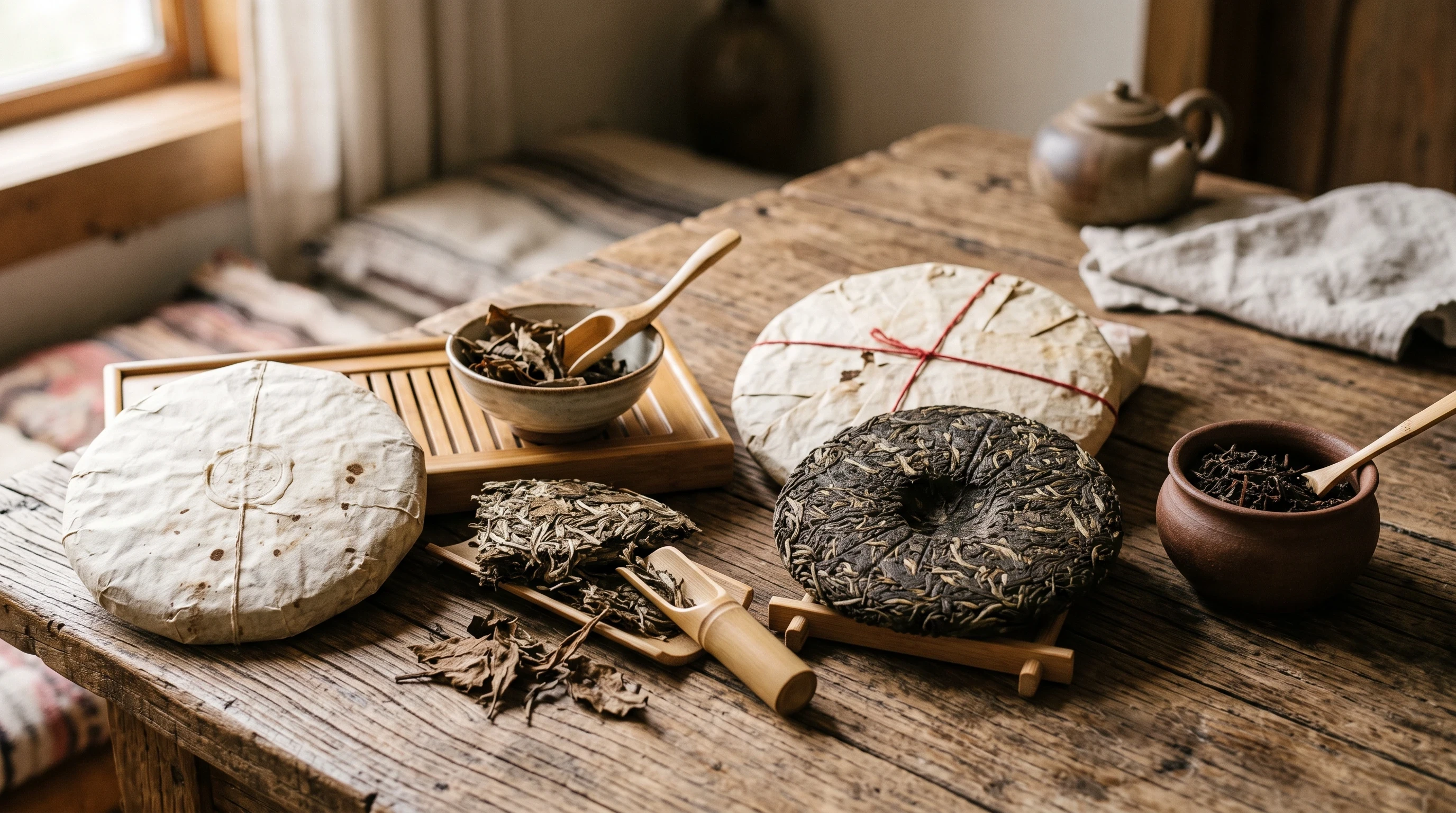
When young, white tea tends to be light, floral, and a little sweet, sometimes with a grassy or hay-like edge. As it ages, that character shifts toward:
- Honey and a soft, sticky sweetness
- Dried fruit, such as jujube, apricot, fig, or prune
- Herbal and hay notes that soften and deepen over time
- Wood and mild spice, occasionally with a cooling, herbal quality reminiscent of Chinese medicinal herbs
Aged white tea is generally low in bitterness and tends to be less astringent than young sheng pu’er. The texture tends to be smooth and rounded, and the sweetness is usually easy to notice without much searching.
Sheng Pu’er
Young sheng can show bright florals, orchard fruit, citrus, or a grassy, vegetal edge, often paired with noticeable bitterness and astringency. As it ages, especially in good storage, it can develop:
- Darker fruit notes, sometimes dried lotus or plum
- Mineral qualities, like a “wet stone” character
- Woody and forest-floor aromas
- Camphor or incense-like notes in well-aged examples
- Earthy, spicy complexity, though generally without the heavier, musty character associated with shou pu’er
These are possibilities, not guarantees. Two cakes from the same year and region can age very differently depending on storage, and not every cake develops the prized camphor or incense notes collectors chase.
Body, Bitterness, and Sweetness
Sweetness tends to build in both teas with age, but it usually shows up sooner and more consistently in white tea. In sheng pu’er, sweetness often follows an initial wave of bitterness, a pattern often described as hui gan, where bitterness gradually gives way to a returning sweetness in the mouth and throat.
A related term, kou gan, refers more broadly to overall mouthfeel rather than this specific bitter-to-sweet shift.
Bitterness is typically low in aged white tea and can range from moderate to quite high in young sheng, softening with time. Astringency follows a similar pattern: mostly gentle in white tea, more noticeable in young sheng.
Aged white tea tends to feel smooth and syrupy, with a relaxed aftertaste. Aged sheng pu’er often has a longer, more layered finish, sometimes with a cooling or faintly minty sensation after swallowing.
Both reward gongfu-style brewing, using more leaf and short, repeated steeps, and sheng in particular is known for dramatic shifts between infusions, moving from intense and bitter early on to soft and sweet several steeps later.
Which Tea Changes More With Age?
Sheng pu’er has the stronger reputation and the deeper collecting culture built around dramatic transformation. Grassy, sharp young cakes can, with time and good storage, turn into something with dark fruit, forest, spice, or incense character, and collectors often taste the same cake year after year to track that evolution.
If you want to try it yourself, our guide to aging pu’er tea at home covers what that actually involves. That said, not every cake develops the way collectors hope; storage, leaf quality, and a fair amount of luck all play a role, and a poorly stored sheng cake can end up flat or unpleasant rather than complex.
Aged white tea changes too, just more gently. Hay and floral notes soften into honey, dried fruit, and mellow wood. It’s a smaller transformation on paper, but for many drinkers it’s just as satisfying.
Neither tea is guaranteed to improve simply because time has passed; good aging requires decent starting material and appropriate storage, not just patience.
Storage Compared
Both teas are sensitive to their environment, though sheng pu’er generally demands more attention. The principles below apply to both; for a broader overview of keeping any tea fresh, see our complete tea storage guide.
Temperature. A stable room temperature works best for both. Avoid attics, garages, or spots near windows and heating vents, where temperatures swing.
Humidity. Both teas need a moderate, stable environment, but the right approach depends on climate: more airflow helps prevent excess moisture and mold in humid regions, while a more enclosed container helps keep tea from turning flat or overly dry in drier ones. There’s no single humidity number that applies everywhere.
Odors and light. Tea absorbs smells easily, so keep it away from kitchens, spices, cleaning supplies, and other scented teas like jasmine or chai. Direct sunlight and UV exposure can also flatten flavor over time, so store away from windows.
Airflow and containers. Some collectors use limited air exchange, such as loosely woven bags or breathable paper, particularly for sheng pu’er. Others use more enclosed containers, like tins or jars, to help maintain moisture in drier climates.
Both approaches are valid depending on conditions; the essential principles are stability, protection from odors, and avoiding condensation or excessive humidity.
Checking on your tea. Periodically check stored cakes or leaves. A moldy, musty, or chemical smell, or visible fuzzy growth, signals a problem, not desirable aging; healthy aging tends to bring gradual aroma changes, not sudden ones.
“Wet storage” pu’er, intentionally kept at higher humidity to speed aging, is a specialized practice best left to experienced collectors.
Storing them together. If both teas are unscented and kept in similar, stable conditions, storing them in the same general space is usually fine. Keep both away from strongly scented items, and use separate containers if you want to manage humidity or airflow independently for each.
Sheng pu’er generally rewards closer attention to humidity and airflow than white tea does, but neither tea should be stored carelessly. For tea-specific detail, we have dedicated walkthroughs on storing aged white tea properly and on aging pu’er at home.
Brewing Aged White Tea vs Sheng Pu’er
Gongfu brewing, using more leaf and shorter, repeated infusions, tends to show off what these teas are doing at each stage far better than a single long Western-style steep. Here’s a practical starting point for both.
| Element | Aged White Tea | Sheng Pu’er |
|---|---|---|
| Teaware | Gaiwan or small clay teapot | Gaiwan (often preferred for young sheng) or clay teapot |
| Leaf-to-water ratio | About 5-7 g per 100-120 ml | About 5-7 g per 100-120 ml |
| Water temperature | Around 90-100°C / 194-212°F | Around 90-100°C / 194-212°F, adjusted down for very young or bitter sheng |
| Rinsing | Optional, but recommended for cakes or bricks | Optional; useful for tightly compressed tea |
| First infusion | Short, roughly 5-15 seconds | Very short, roughly 3-10 seconds |
| Later infusions | Increase time gradually as flavor fades | Increase time gradually as the tea softens |
| Number of infusions | Often 6-10+, depending on the tea | Often 8-15+, sometimes more with high-quality material |
| Adjusting for bitterness or weak flavor | Use slightly less leaf or shorter steeps if too strong | Cut infusion time and use less leaf if bitterness is too sharp; extend time if flavor feels thin |
Hotter water generally draws out more strength and intensity, while dropping the temperature a bit can soften both bitterness and body if the tea feels too aggressive.
Hitting those temperatures consistently is easier with a variable-temperature kettle; we cover the options in our roundups of smart kettles for precision brewing and kettles suited to gongfu sessions. Water itself matters too, and our guide to brewing better tea with the right water explains why.
Both teas can be brewed Western-style with a single longer steep, but you’ll lose some of the layered detail gongfu brewing reveals. For step-by-step parameters, see our dedicated guides to brewing aged white tea gongfu style and brewing sheng pu’er gongfu style.
Which Is Easier for Beginners?
Aged white tea is generally the more forgiving option: less prone to bitterness, brews well across a wide range of temperatures and steep times, and the flavor profile (honey, dried fruit, soft sweetness) tends to be immediately likable.
Shou Mei and Bai Mu Dan are both reasonable starting points, and if you’re still assembling your setup, our guide to choosing a tea brewer is a good place to begin.
Sheng pu’er asks more of a new drinker. Young cakes can turn sharply bitter or astringent if brewed even slightly too strong, and there’s a real learning curve around sourcing clean, well-stored tea and interpreting vintage claims.
Most early disappointments come down to technique rather than the tea itself, so it’s worth knowing the common gongfu mistakes before you write off a cake. Some beginners are drawn specifically to sheng’s intensity, so “harder for beginners” doesn’t mean “wrong for beginners,” just a steeper learning curve.
Price, Collecting, and Buying Risks
Both categories have active collector markets, but pu’er’s is older, larger, and more complex. Sheng pu’er pricing is influenced by the producing region or mountain, the factory or maker, the vintage, and documented storage history; well-regarded regions and producers can command significant prices with age and good provenance.
Aged white tea’s collector market is smaller and generally more affordable, though interest has been growing for well-made compressed cakes from reputable producers.
A few things worth keeping in mind before buying either tea:
- Sample before committing to a full cake or brick whenever possible. Quality varies a lot even within the same style, origin, and stated age.
- Buy from vendors with a track record, who are more likely to store and describe their tea accurately.
- Ask about storage history. Where and how a tea was stored affects flavor as much as its age does.
- Be skeptical of age claims. A wrapper stating an age doesn’t guarantee it’s accurate or that the tea was well cared for.
- Watch for counterfeit or misleading packaging, a known issue in the pu’er market in particular.
- A high price doesn’t guarantee a better tea, and an old tea isn’t automatically a bargain. Poorly stored old tea can be worse than a well-made young one.
For most drinkers, especially those newer to aged tea, it’s more useful to focus on what you actually enjoy drinking than on chasing investment value or rare vintages. If you’re shopping online, our guide to choosing aged white tea without getting burned walks through the warning signs.
Aged White Tea or Sheng Pu’er: Which Should You Choose?
There’s no universally correct answer, it depends on what you’re looking for.
Aged white tea may suit you better if you prefer soft, honeyed sweetness, dried fruit and herbal notes, low bitterness, and an easier introduction to aged tea. Start with a Shou Mei or Bai Mu Dan brewed gongfu style.
Sheng pu’er may suit you better if you prefer stronger shifts across infusions, the bitter-to-sweet pattern known as hui gan, more intensity, and an interest in comparing regions, vintages, and producers over time. A careful gongfu session is the best way to meet it on its own terms.
Plenty of tea drinkers end up enjoying both, for different moods and occasions.
Frequently Asked Questions
Is aged white tea the same as pu’er?
No. They’re different tea categories made from different leaf material and different processing methods. Aged white tea comes from lightly processed white tea leaves, while sheng pu’er comes from Yunnan large-leaf material that’s fixed, rolled, and sun-dried, then sold loose as maocha or compressed into different shapes.
Is sheng pu’er the same as ripe (shou) pu’er?
No. Shou pu’er undergoes intentional pile fermentation for a faster, darker, earthier result. Sheng pu’er is raw and ages slowly over years without that fermentation step.
Does white tea ferment as it ages?
Not in the same dramatic way pu’er does. White tea’s changes are driven mainly by oxidation and enzymatic activity, though some research suggests microorganisms may play a supporting role in its transformation during storage as well.
Which tea is easier to brew?
Aged white tea is generally more forgiving and better suited to beginners. Sheng pu’er requires more attention to avoid excessive bitterness, particularly when the tea is young.
Can aged tea go bad?
Yes. Poor storage, especially excess humidity, can lead to mold, mustiness, or off flavors in either tea. Good storage is what allows aging to work in the tea’s favor rather than against it.
Should white tea and sheng pu’er be stored together?
If both are unscented and kept in similar, stable conditions, storing them in the same general space is usually fine.
Keep both away from strongly scented items, and consider separate containers if you’re aging either one seriously over the long term. Our guides to storing aged white tea and general tea storage go into more detail.

Chris is the founder of Zen Tea Tools and a passionate explorer of traditional and modern tea brewing. From Gongfu sessions to smart tea technology, he shares practical insights to help others find clarity, calm, and better tea.Learn more about Chris →
Leave a Reply